CATERINA BUTES AND THE MONA LISA

No written documents exist to certify her identity: the name attributed to the woman portrayed was chosen by historians more out of editorial necessity than historical certainty. Traditional interpretations, in fact, were based on "romantic" readings, lacking any rigorous semantic analysis, and were therefore doomed to error from the very start.
The starting point for a logical argument is an objective fact: that painting, extraordinarily "finished," belonged to Leonardo himself. We know this thanks to the testimony of Antonio de Beatis, who in his diary records his visit to the master's studio in Amboise, describing the paintings in the Master's possession: the "Lady of Lombardy" (the Mona Lisa), the Saint Anne with Mary and Jesus, and the Young Saint John. These works remained in France and were later sold to the royal family.
It is worth recalling that commissioned portraits, by custom, did not remain in the artist's hands for long: when a patron sat for a portrait, the work was carried out in the patron's own residences and stayed there until delivery. If Leonardo, then, jealously kept that painting, it means its origin was quite different from that of a simple commissioned work.
If that face, then, did not belong to just any patron, but remained in Leonardo's hands until the end, it is because it held a secret that no other portrait carried. A secret that tradition has obscured, but which careful analysis of documents and symbols can finally bring back to light.
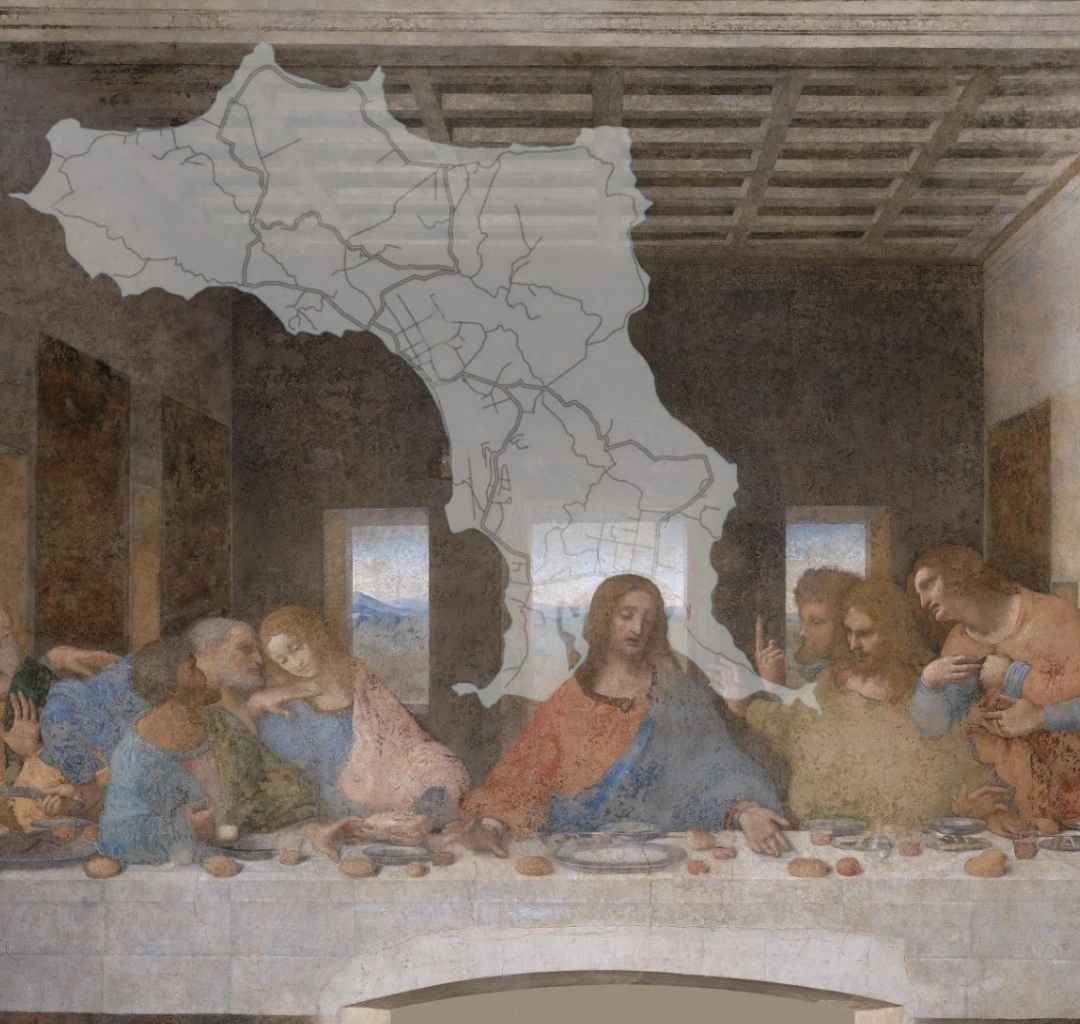
The reading I now describe is based on the study of the semantics of Leonardo's paintings. At the start, I used the primary method — that is, the cataloguing of signs, subliminal and connecting signals, symbols, and doubled elements. I begin with the image of the painting known as the "Mona Lisa." To give an example of a subliminal form, we can trace a series of identifying projections: the construction of the mantle resting on the shoulder, extended into a small portion of the landscape, evokes the subliminal form of a kite (the bird — nibbio) (see the accompanying demonstrative overlay). The drapery of the sleeves repeats the patterns of natural plumage, while the fingers of the left hand serve as the terminal point, like a tiller/rudder.
The kite is also the figure Leonardo describes in the account of a dream he had in his cradle:
"This writing so distinctly about the kite seems to be my destiny, because among the first memories of my infancy, it seemed to me that, as I was in my cradle, a kite came to me and opened my mouth with its tail, and struck me many times with its tail within my lips." (Leonardo)
(Note: the original Italian passage is Leonardo's own words from the Codex Atlanticus, given here in translation; the wordplay in the semantic reading that follows works only in the Italian.)
Through this subliminal overlay, Leonardo describes the meaning of the dream: the terminal end of the "tiller" ends in the mother's fingers, a recollection of the custom of using them as a pacifier. The meaning is transformed, granting the mother a power of spiritual elevation, and inscribing the symbol as one of the most significant of the civilization from which Caterina's origins came.

The Mona Lisa: demonstrative overlay of the subliminal symbolic image of the kite
Here I present some of the many symbolic elements that can be read in the work; each element described by Leonardo serves the second-level reading of the "constellation codes," as I have detailed in my publications.
List of symbols present in the portrait: Lyre, Dolphin, Island, Serpent, Kite, Bridge, the letter "C" for Caterina, the name Butes, the Sea.
The image we know as the "Mona Lisa" is not simply an enigmatic face: it represents Leonardo's mother, as Freud himself had already hypothesized, reading her smile in symbolic terms. Confirming this truth, details emerge that certify her identity and her name of origin.
Looking closely at the painting, on the Spanish-style dress (camora), a small pendant appears; within that ornament a name is skillfully concealed. It takes only a little concentration and, once spotted, it becomes unmistakable: the hidden name is "Butes."
Taken together, all the symbolic clues left by Leonardo reveal that the face in the world's most famous painting belongs to Caterina, whose original name was Butes.
We know that Leonardo's mother's surname was Buti: that final "s" is not accidental, but charged with meaning. My research, building on the results already reached in the study of the Virgin of the Rocks, leads back to the Taíno cultures. In the Arawak-Kalinago language, the word "butes" means "blue" — the color of the sea.

Comparison and identification of the dolphin shape within the rock formation

Subliminal trace within the garment, where the name of Caterina's origin can be identified: BUTES

Enlarged detail
With these codes, Leonardo celebrates Caterina, transforming the portrait into the eternal memory of his mother: not a commissioned work, but his true emotional and spiritual testament. Caterina's portrait presents a complex and intricate construction whose meanings indicate it was completed after her death, which took place in Milan in 1493. The work thus becomes his Orphic song — recalling the myth of Orpheus, the musician and singer who descends into the underworld and, singing to the gods, is granted the chance to see Eurydice again. In the same way, Leonardo, through his art of painting, drawing, and the study of anatomy, sublimates his mother's face onto the surface of the panel, and sees her one last time.