THE SALVATOR MUNDI — THE CONSTELLATION CODE
THE SALVATOR MUNDI — THE CONSTELLATION CODE
There is a mystery surrounding the Salvator Mundi, the celebrated painting attributed to Leonardo da Vinci. This work, painted in oil on a walnut panel between 1505 and 1515, depicts Christ in the act of blessing, holding a crystal orb in his left hand. It is also known as the "Cook version," after the London collector Francis Cook, who kept it for almost sixty years.
But behind that image of apparent serenity, Leonardo concealed an enigma. It is my conviction that, after years of research, I have uncovered the secret — what I have been able to read in this painting is found in no written document.
The semantic analyses point to a constant and repeated process, revealing his intentions. Leonardo points us toward meanings that go beyond what the work depicts on its surface.
The path of discovery
My publications, beginning in 2024 — the books The Secrets of Leonardo and Leonardo, The First Book of Secrets — grew out of an in-depth study of all his painted works.
I came to understand that Leonardo did not create from nothing, but always started from forms and symbols already existing in nature, which he transformed into a complex and allusive visual language.
I have called this language the function of a metalinguistic code, or "constellation code." It is an invention — a system capable of generating words and phrases starting from images. It is the key to understanding his most intimate secrets.
The constellations in Leonardo's paintings
Leonardo built his works in two phases:
The symbolic structure — a set of signs and forms that guide the correct reading of the image.
The constellation code — a map of points and lines that, like the stars in the sky, form shapes and, in turn, words.
In almost all of his paintings, I have identified the presence of at least nine constellations.
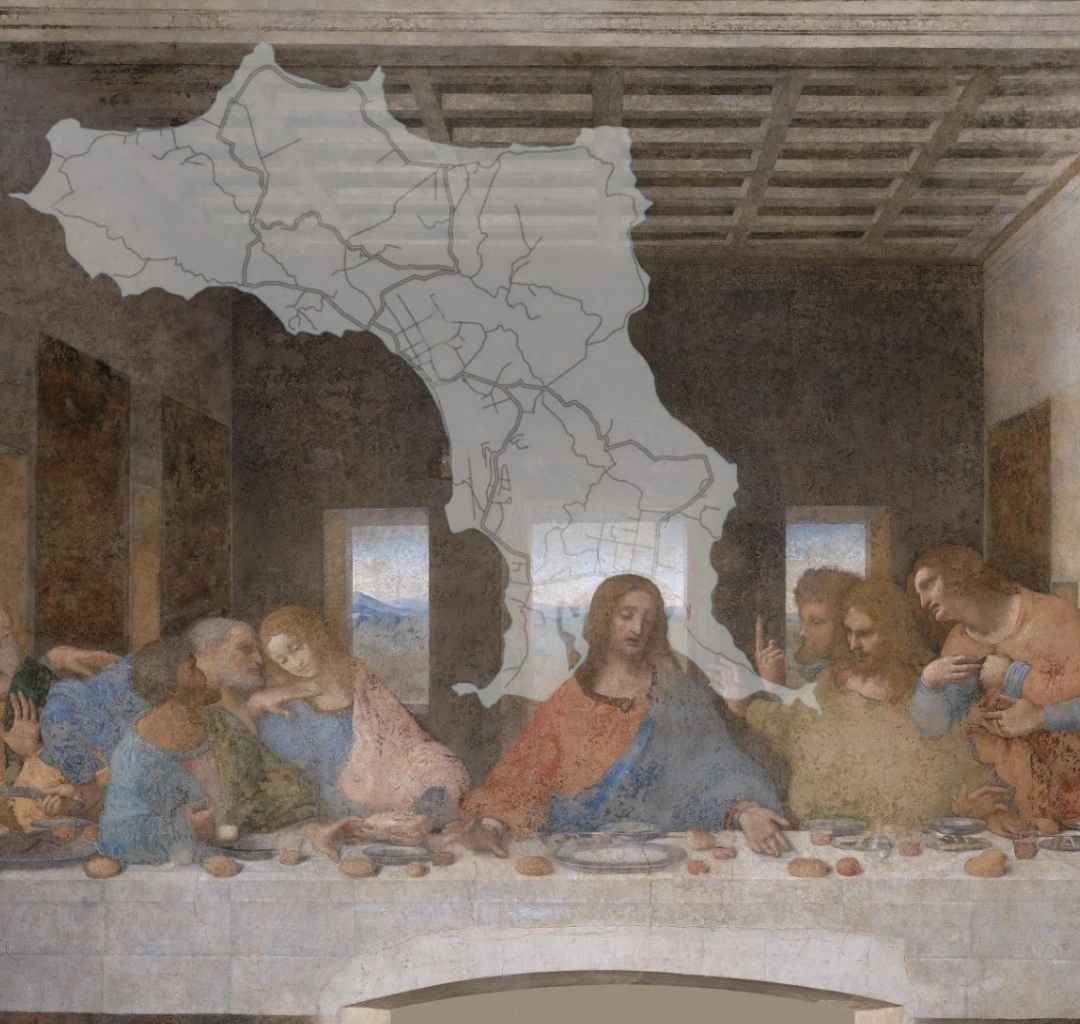
In the Salvator Mundi, the constellation of Delphinus (the Dolphin) clearly emerges.


From this rebus the following words emerge:
"CRISTO, BENEDICE, BEZOARIO, SFERA, CRISTALLO, DELFINO"
(Christ, blesses, bezoar, orb, crystal, dolphin)
Recomposed as an anagram, the message that appears is striking:
"SE CONFIDO DI ESSERE FRATELLI LORENZO TI ABBRACCIO"
("If I trust that we are brothers, Lorenzo, I embrace you")
(Note: this rebus and anagram work only in the Italian original.)

Overlay of the constellation of Vulpecula (the Little Fox)
Rebus:
COLLO, GOLA, BEZOARIO, SFERA CRISTALLO, INDICE
(neck, throat, bezoar, crystal orb, index finger)
Anagram:
ACCOLGO LORENZO, SA. DICE: FRATELLI LABORIOSI.
("I welcome Lorenzo. He knows. He says: hardworking brothers.")
(Note: this rebus and anagram work only in the Italian original.)
A secret brother
The message seems to reveal a hidden family bond: Lorenzo as Leonardo da Vinci's blood brother?
All the results of the decodings I have published have precisely identified this half-brother on their father's side: Lorenzo de' Medici. A secret that casts new light not only on the artist's life, but also on the political and personal context surrounding him.
Beyond the mystery
Leonardo was agnostic, but deeply curious about reality and its symbols. Through the language of the constellations, he left to posterity not only his own story, but a map for understanding his deepest thinking: a bridge between science, art, and spirituality.
The Salvator Mundi, then, is not merely a portrait of Christ in blessing — which I believe is its more fitting title — but a secret page of his diary, written in the language of the stars.
From the anagram's phrase, we can deduce that the painting was created to be given to Lorenzo de' Medici as a brother. Leonardo was aware of this from a young age, and kept the secret. The painting was made in response to Lorenzo's acknowledgment to Leonardo; only such an act could have motivated him to express his gratitude by making an extraordinary gift — a painting consecrated in the figure of Christ, kept secret through an enigmatic game understandable only to the two of them.
Lorenzo died in 1492, so we can make some conjectures: the painting was begun before that date, and so, once death came, Leonardo was never able to give it to him.