THE VINCIAN LAST SUPPER

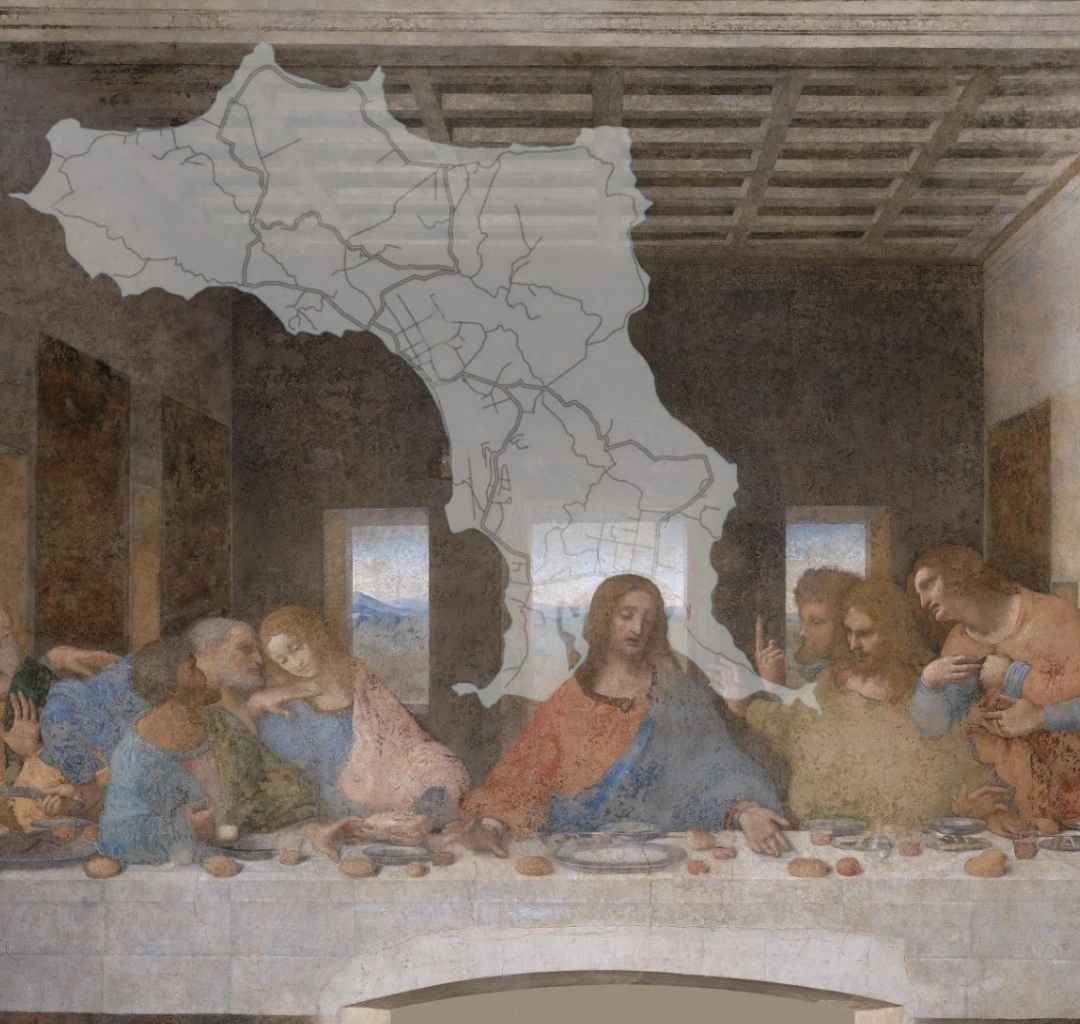
After several analyses and attempts to fit the shape of the island of Carriacou, I obtained a result: in this work too, Leonardo uses cartography to give structure to the figure of Jesus. His hands repeat the same shape as the two projecting points (or peninsulas) of the island opening onto the bay; the profile of the head and shoulders fits perfectly within the outline of the bay, with identical sinuous lines. For Leonardo, the island becomes a divinatory symbol, the content, the creative seed of the form. Everything we see in the Last Supper originates and develops from knowledge and from "the unseen."
At this point, we can infer that the entire work of the Last Supper, just as in the Virgin of the Rocks, is a celebration of the mother's origins.
The resemblance and the identification
The figure to Jesus's right is identical to the figure in the Virgin of the Rocks. Both bear the bezoar at the center of the chest, while the Virgin's hand is mirrored and transposed onto Jesus. This represents a passing of the torch — a principle of complete identification with the mother.


We can also note the compositional dynamic between the two figures: they are separated by a symbolic space of "division." The pilaster gains mass, and, from a sensory point of view, becomes a "heavy, pointed boulder."
This is a signal of DIVISION, or a condition of deprivation — certainly not the result of individual choice, but induced by others.
Leonardo chose to give the apostle whose hand is raised toward his throat the likeness of Pope Sixtus IV — an eloquent choice, I would say. This is the figure of Peter, founder of the Church of Rome, placed beside the figure of Judas, who holds a knife concealed in his hand.

Overlay and identification of the hand from the Virgin of the Rocks — Leonardo mirrors it and reuses it as the hand to Christ's right.

