THE ISLAND OF MOTHER CATERINA
The Island of Mother Caterina
The first step: the Procession of the Magi
The first step was the study of The Procession of the Magi by Benozzo Gozzoli, which gave me near-certainty that I needed to investigate in that same direction within Leonardo's paintings as well — a visual narrative of the Florentine families and their connection to the new lands discovered across the ocean.
The overlays on the Virgin of the Rocks
Even before identifying the tiny shape that would later reveal itself to be a real island, with a name, I tried overlaying the outlines of various Caribbean islands onto the composition of the Virgin of the Rocks. Among the many shapes tested, one fit perfectly into the center of the figures' composition — a sign that the direction of the research was the right one.
The confirmation and the name: Carriacou
Only later did confirmation come for the small pale mark, until then considered insignificant within the painting. It was at that point that I was able to give that shape a name: Carriacou.

Island Carriacou - Antille

Overlay of the island at the center of the iconographic composition

Subliminal trace of the island — detail
The reading that follows reinforces certain theses about the mysteries of Leonardo's life. So far, signals have been identified pointing to Leonardo's presumed genealogical ties to the Medici and Tornabuoni families. The next step was to study in depth the outline patterns of Leonardo's painting and compare them to the geographic shapes of various Caribbean islands. After several attempts using computer software, testing both larger and smaller islands, I obtained a result: a very small island with an intricate shape, belonging to the archipelago of the French Antilles.The island represented here is CARRIACOU (Caribbean); it fits perfectly into the central body of Mary's figure, interlocking around John's hands and the yellow mantle (a symbol of the maternal womb of birth). The fingers of Mary's left hand trace the island's outline with extraordinary precision. The Archangel Uriel is overlaid as if to indicate the place, following the movement of Jesus's blessing hand — Leonardo intended to represent the island as the birthplace, the origins of Caterina.The satellite image of the island's outline shown here is, of course, a modern one, while the shape as it could have been known in Leonardo's time would certainly have carried some approximation.We can read the compositional structure of The Virgin of the Rocks as a whole made of symbolic, subtle, and interpenetrating forms — a synthesis of the narrative between the history of sacred scripture and his own personal life. Leonardo fixes and impresses onto the work the mystery surrounding his life, indissolubly bound to his childhood.
THE ISLAND IN SAINT ANNE AND THE VIRGINWith extraordinary precision, Leonardo builds the structure of the painting with clear intent — a kind of divinatory principle of formal composition. He places, interlocked at the base of the three figures of Mary, Jesus, and the lamb, the island of his mother Caterina: Carriacou. We can notice how the shape of the lamb's leg and the lower tip of the island repeat, identical to one another.The two mothers — she who gave him birth, a Tornabuoni, poses with a symbolic sense of "detachment," while Caterina, who raised him, is shown with

Saint Anne with the Virgin and Child — overlay of the island of Carriacou
THE ISLAND IN THE LAST SUPPER
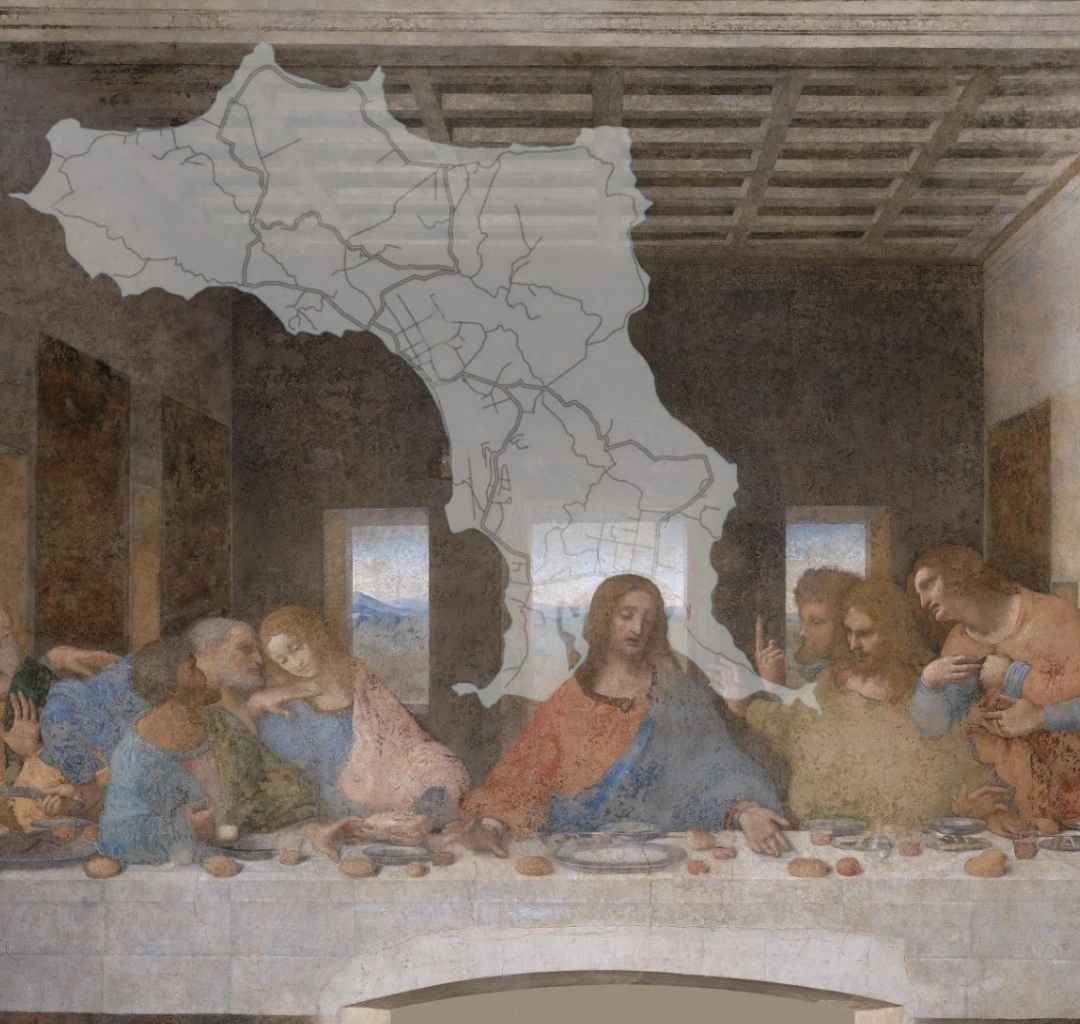
The two prominent points of the bay of Mother Caterina's island, "Carriacou," are used as the drawing form for Christ's arms and hands; the same shape, along with the profile of the head and shoulders, fits together perfectly. For Leonardo, the island becomes a divinatory symbol: its form and content are the celebratory seed of the mystery of "sacrifice" and of his affectionate, loving bond with his mother Caterina.

Overlay of the island: Leonardo used the geographic shape as a compositional and iconographic principle — form and proportion.

Leonardo draws inspiration from the two projecting points of the bay, resembling two limbs; Christ's hands repeat this shape, one open upward and one open downward.