PROCESION OF THE MAGI

Detail of the mirrored image of the Virgin of the Rocks. Overlay identifying the profile subtly worked into the foliage: the face of Lorenzo, known as the Magnificent.

The Procession of the Magi
Benozzo Gozzoli, The Adoration of the Magi, 1459
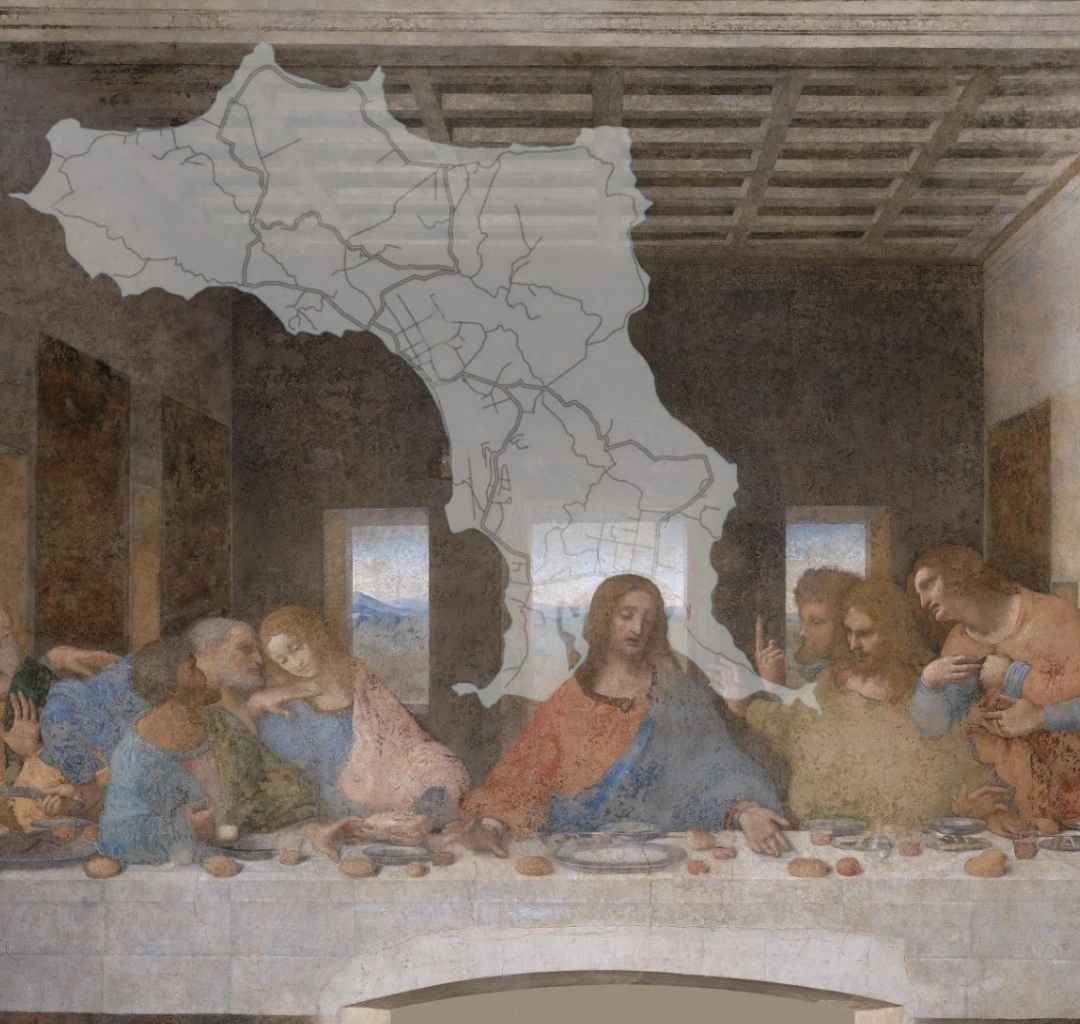
I believe this new subject is directly connected to the image shown above of Lorenzo the Magnificent, whom I have identified as a trace drawn and concealed within the foliage, with his profile turned toward shapes suggesting geographical forms — such as an island I identified, by resemblance, as Jamaica, visible in the photographic overlay, along with the Americas rendered in symbolic form.
My research led me to look further in several directions, seeking more confirmation and certainty. The most significant insight came from observing the frescoes of the Adoration of the Magi, a painting celebrating the same Medici family — depicting a journey undertaken jointly by important families toward exotic lands. Within the meaningful forms of the landscape one can read a structure resembling a geographic map: rocks and shapes resembling islands and continents can be made out.
Working with a program to overlay cut-out images of Caribbean islands, I identified — approximately, despite Benozzo Gozzoli's Gothic style — the intention to represent a cartography of the Americas (see photo). Beneath the horses' hooves in the foreground, a shape can be seen representing the crossing of the Yucatán region; the procession moves from left to right, from north to south. Beneath the hooves, grooves are depicted indicating the passage through the Panama Canal. The figures in the background narrate the chronological path: the first landfall on the islands (rocks in the upper left of the painting), while the mounted figures within the gorge represent the crossing to the continent. Another significant element is the depiction of birds placed at the sides, indicating a fundamental navigational aid — their sighting served to orient travelers toward migratory directions.
While this reading is intuitive, further confirmation is always needed. If voyages and contact with the American continents took place at least 50 years before Christopher Columbus's official voyage, then — in the absence of documents — we must assume that the nature and purpose of those journeys, for political and economic reasons, could not be revealed at that time; the painting is deliberately rendered only in symbolic form. If the motivation of these "families" for undertaking so significant a journey was primarily economic, this would explain their wish, above all, not to reveal their sources of profit (free trade) and to increase their power relative to competitors — the Church, the maritime republics, and foreign states. Intuitively, I would say that if this is indeed what happened, they benefited from it, given their remarkable growth in the second half of the 1400s.

Identifying projection of the island of Jamaica

Identifying projection of the island of Cuba

Island of Dominica